John Fite

Lab

Where I test AI systems instead of just using them: what they can do, how to check them, and where human judgment has to stay in charge. Sentinel is public now. Krinel has a working prototype. Two more projects are on the bench.

Sentinel

Agent security lab, open source under Apache-2.0

Does the action match the authorization?

An open-source testnet lab. Before an AI agent’s proposed blockchain transaction runs, Sentinel checks it against the mandate a person actually signed, and only that exact, checked call can execute.

Testnet lab; no production security guarantee.
A transaction can call an allowed contract and stay under a spending limit while sending the purchase to the wrong person. Sentinel gives that failure a reproducible test: does this proposed action conform to what the owner signed?

The proposer has no signing authority. An evaluator checks the call’s decoded arguments and simulated effects against the mandate. A signer in a separate process attests the decision, and an execution contract checks that the submitted call matches the signed record.

You can follow that sequence through the source code, run the failure cases, and verify signed decision records. The repository includes the tests, adversarial findings and corrections behind its claims, so you can examine both the mechanism and the evidence for it.

Human authorization. Exact calls. Inspectable evidence.

Run the demo
One authorized purchase executes. Seven negative controls verify refusals for a changed recipient, altered calldata, a wrong deployment authority and receipt replay. The demo runs locally with Node.js, Foundry and Python; it needs no LLM account, funded wallet or remote RPC service.
Inspect the record
Solidity contracts, a TypeScript evaluator and isolated signer, signed receipts, and Python verification tools. The architecture guide explains the trust boundaries; the review index maps the findings and decisions.
Know the limits
The evaluator is trusted to decode the call. Offline verification cannot establish live chain state, and per-action limits do not cap cumulative losses. Testnet-only use is documented, not enforced. Read the full boundaries.
Status
Public on GitHub under Apache-2.0. Source, documentation and a runnable local demo are available for technical evaluation.
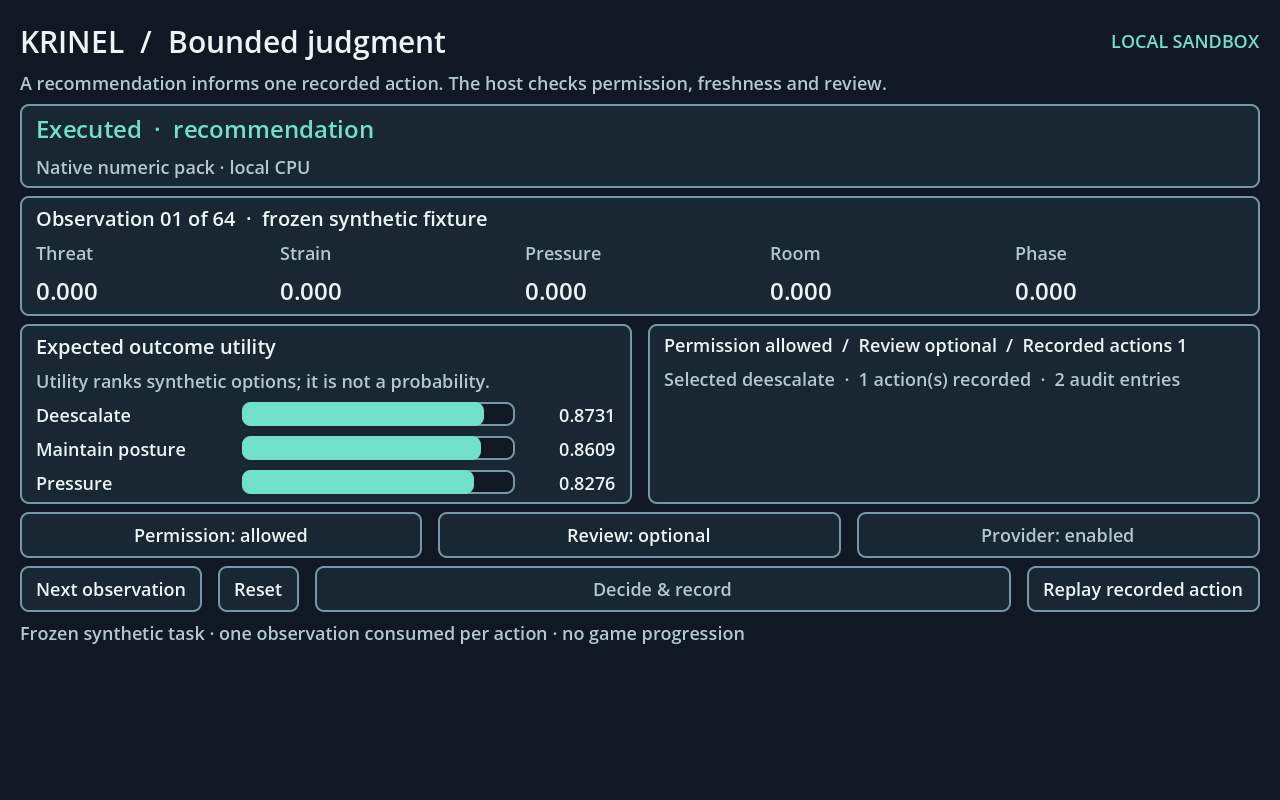
Krinel’s local synthetic demo, showing option rankings, permission and review checks, and a recorded action.

Krinel

Local AI research prototype, in development

Small models. Bounded judgment.

I’m building Krinel to give ordinary software a small, local judgment layer. It recommends from a fixed set of options while the application keeps control of permissions, approvals, and execution.

The working CPU prototype needs no cloud service or API key. Its synthetic demo shows recommendations, recorded actions, replay, and fallback when the model is unavailable.

Text-based judgment is still under evaluation. Public code and a runnable demo have not been released.

Also on the bench

Neither has a public demo yet.

In early build

Tiny LLM Lab

Build a small language model to understand how it works and where it fails. Then explore a local, retrieval-assisted workflow with each step open to inspection.

In design

Project Euclid

An AI-assisted mathematics research process combining language models, symbolic tools, search, and formal verification. Progress must leave a checkable trail from conjecture to proof.

What belongs in the Lab

Sentinel is available to explore now. More project code and write-ups will be linked here as they’re released.

Learning labs
Builds you can open up to see how the machine, and the workflow around it, really work.
Focused prototypes
Small demos aimed at one real point where trust can break, rather than all-purpose platforms.
Reference pieces
Stable work that later projects can link to and build on.